In 2026, arguing about the market mostly means arguing about chips. And nearly every one of those arguments makes the same mistake: it treats "semiconductors" as one trade. It isn't. This July, memory stocks sat in a full bear market while AI accelerator names reported the best quarters in their history — the same industry, moving in opposite directions at the same time. This is the first piece in our Industry series: a map of the five very different businesses hiding inside the word, and then something nobody else can show you — what a fully sealed, published-every-morning AI engine actually did with its 11 chip names while the split played out.
One word, five businesses
Say "semiconductors" and most people picture one company. But the industry that sold $791.7 billion of chips in 2025 (per the Semiconductor Industry Association, up 25.6% year over year) is really a stack of distinct businesses with different customers, different pricing power, and — this is the part that matters for markets — different cycles. Our engine's 101-ticker universe carries 11 chip names across all of them:
| Segment | In our universe | What it actually sells | Where it stood this week |
|---|---|---|---|
| AI accelerators & GPUs | NVDA, AMD | The compute behind AI training and inference | AMD's Aug 4 report: record $11.5B revenue, data center up 107% YoY |
| Custom silicon & networking | AVGO | Hyperscalers' in-house AI chips, plus the switches that connect them | AI semiconductor revenue up 143% YoY last quarter; targets over $100B of AI revenue in FY2027 |
| Foundry | TSM | Manufactures nearly everyone else's leading-edge designs | Q2: $40.2B revenue (+36%), record 67.7% gross margin |
| Memory | MU | DRAM, NAND, HBM — commodity pricing, brutal cycles | In a bear market since late June, whipsawed back up this week |
| Equipment | AMAT, LRCX, KLAC | The machines that make the machines | Lam Research posted record quarterly revenue July 29; 2026 spend forecasts raised |
| Analog & embedded | TXN | Power, sensing, auto, industrial — chips for the physical world | Q2 revenue up 23% YoY as industrial demand recovered |
| Mobile & connectivity | QCOM | Smartphone processors and modems | Handset headwinds — the corner AI capex doesn't reach |
| Integrated device maker | INTC | Designs and fabs its own — the turnaround story | Rode July's AI momentum; foundry ambitions still unproven |
Before the split, the scale. Chips are often discussed like a story stock — they're better understood as industrial capacity. U.S. semiconductor and electronic-component production is up roughly 32-fold since 2000, compounding straight through the dot-com bust, the financial crisis, and every "chip winter" in between:
The split of 2026
Now the part the single-word framing misses. Around June 25 this year, the memory complex broke: within two weeks, major memory names — Micron among them — were more than 20% off their highs even as the broader market held near records, a selloff widely attributed to a valuation reset after a monster run. Then a structural fear landed on top: China's CXMT, a DRAM maker that had roughly tripled its global share to about 8% in a year, went public in Shanghai on July 27 and closed its first session up 466% — instant, well-capitalized commodity-DRAM competition, arriving precisely while the incumbents pour their capacity into high-bandwidth memory for AI.
And then the tape flipped again. In early August, widely reported comments from a SpaceX earnings call — that AI memory demand is "increasing by 200% a year, maybe higher" while supply grows a fraction of that — helped send the same beaten-down memory names ripping back. Meanwhile the AI-accelerator side never blinked: AMD printed the biggest quarter in its history, TSMC's gross margin hit an all-time record, and the industry group WSTS revised its 2026 forecast to $1.51 trillion in global sales, up 90% — a Spring 2026 revision dramatically above its own autumn outlook, driven overwhelmingly by memory pricing. One industry. Two opposite tapes. Reversals violent enough to whipsaw both inside a single week.
What a sealed engine actually did with chips
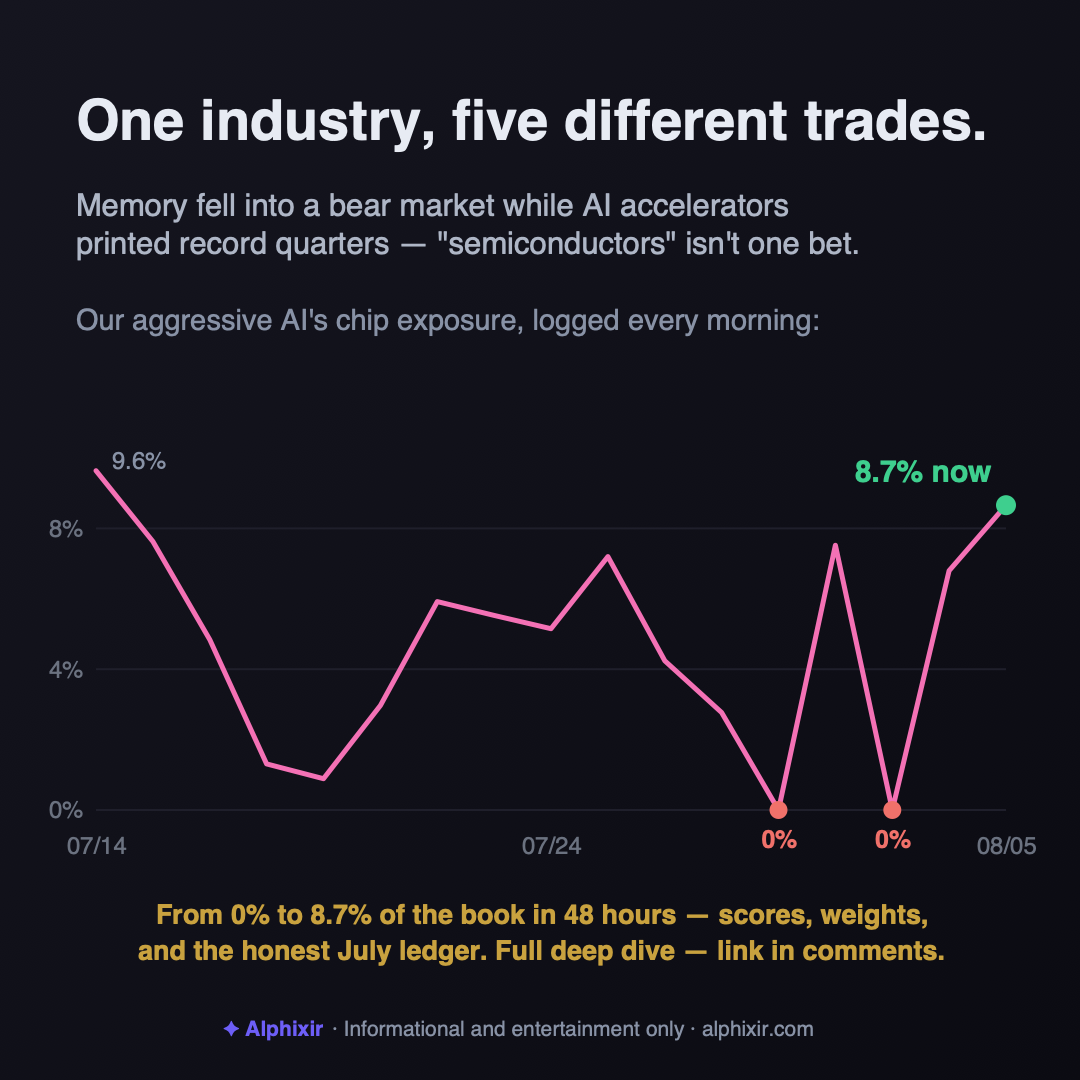
Here's the part you can't get from commentary: a live record of decisions. Every trading morning our engine scores all 101 names in its universe, and four strategies — Meridian (core), Maverick (aggressive), Sentinel (conservative), Regent (sector champion) — size their virtual books from those scores under their own risk rules. The weights are sealed before the open and published unedited, losers included. Sum each strategy's weight across the 11 chip names and you get its "chip sleeve." Here is that sleeve, sealed morning by sealed morning, through the split:
Read it like a dial, not a conviction. The sleeve peaked near 10% of Maverick's book in mid-July, bled down as the chop punished tech longs, and went to zero twice — July 30 and again August 3 — when chip scores sagged below the engine's entry bar. Then it rebuilt in 48 hours: by this morning, August 5, three of the four strategies were long nine of the eleven chip names (all flagged "up," none short), with Maverick's sleeve back at 8.7%. The engine's regime dial had turned risk-on on July 31 and chips were leading again; it followed its numbers back in. One strategy plays it differently by design: Regent, the sector champion, holds exactly one chip name — NVDA — as its Technology pick, and has kept some NVDA on its book on 19 of the last 21 sealed sessions, the most persistent chip position in the record.
This morning's scores, unsealed
Each name also carries a composite score (0–100) built from four sub-reads — technicals, sentiment, macro, catalysts — generated before the open and sealed with the picks. Two things stand out in today's set. First, the engine's chip enthusiasm is broader than one name: AVGO and AMD top the list, not NVDA. Second, compare today against the trailing week and you can see how fast the complex re-rated — most of these names averaged in the low 50s over the prior seven sealed sessions:
| Ticker | Segment | Score (Aug 5) | 7-session avg | Sealed call |
|---|---|---|---|---|
| AVGO | Custom silicon | 72.5 | 57.6 | up |
| AMD | AI accelerators | 72.5 | 52.9 | up |
| TSM | Foundry | 70.0 | 57.1 | up |
| MU | Memory | 70.0 | 51.1 | up |
| LRCX | Equipment | 70.0 | 56.4 | up |
| AMAT | Equipment | 70.0 | 56.8 | up |
| NVDA | AI accelerators | 67.5 | 56.4 | up |
| TXN | Analog | 67.5 | 53.6 | up |
| INTC | Integrated | 65.0 | 55.1 | up |
| KLAC | Equipment | 60.0 | 57.9 | neutral |
| QCOM | Mobile | 55.0 | 47.9 | neutral |
The shape of the list tells the industry story on its own: the AI-capex chain (custom silicon, accelerators, foundry, equipment) clusters at the top; memory scores rebounded with this week's demand headlines; and the one segment the AI buildout doesn't touch — smartphone silicon — sits at the bottom, still flagged neutral. Even Intel's turnaround reads as a momentum trade here, not a conviction.
The honest ledger
Transparency means publishing the part that hurt. Being long chips through the July chop cost the engine money, and the sealed scoring record says so plainly: across 257 strategy-position-days in chip names from July 10 to August 4, the average daily return was −0.81%. Only one of the eleven averaged positive:
| Ticker | Position-days | Avg daily return | Best day | Worst day |
|---|---|---|---|---|
| INTC | 12 | +0.22% | +5.16% | −4.83% |
| NVDA | 38 | −0.17% | +3.67% | −5.67% |
| TXN | 24 | −0.31% | +3.22% | −3.05% |
| TSM | 30 | −0.37% | +1.98% | −3.19% |
| AVGO | 27 | −0.54% | +4.80% | −3.19% |
| MU | 21 | −0.81% | +5.95% | −9.66% |
| KLAC | 21 | −1.02% | +3.93% | −4.60% |
| QCOM | 15 | −1.26% | +2.79% | −5.97% |
| LRCX | 12 | −1.30% | +2.99% | −5.41% |
| AMD | 24 | −1.57% | +4.39% | −7.10% |
| AMAT | 33 | −1.87% | +2.81% | −6.56% |
The whole split is captured in one row: MU delivered both the best single chip day in the record (+5.95%, July 21) and the worst (−9.66%, July 31) — ten days apart, in the same name, held by the same strategies. That's memory. And the ledger's bottom line is the price of discipline: an engine that stays exposed to a hot industry through its chop will pay for it in windows like this, and the only honest response is to show the bill. This week's rebound isn't in these numbers yet; it will be scored and published the same way, win or lose.
1. "Semiconductors" is five businesses on five cycles — this summer proved it, with memory in a bear market inside a record AI boom, then snapping back on a single week's headlines.
2. Our engine treats chip exposure as a dial, not an identity: 0% to 8.7% of the aggressive book inside 48 hours, every step sealed before the open — including the two mornings it held none at all.
3. The ledger is public either way: 257 chip position-days into early August averaged −0.81% a day. Patterns and process, not predictions.
Informational and entertainment content only. Not investment advice, and never a recommendation to buy or sell any security. Engine data (weights, scores, returns) comes from Alphixir's sealed virtual-portfolio record — simulated positions, no real money. Industry facts from SIA/WSTS releases, company earnings reports (AMD, Broadcom, TSMC, Texas Instruments, Lam Research), and widely reported market coverage as of August 5, 2026; production chart from FRED (IPG3344S). Past patterns are not predictions.