Most days the financial press leads with the S&P 500. But there's a quieter number under the hood that arguably matters more — the one that helps set the price of almost every asset on earth: the 10-year U.S. Treasury yield.
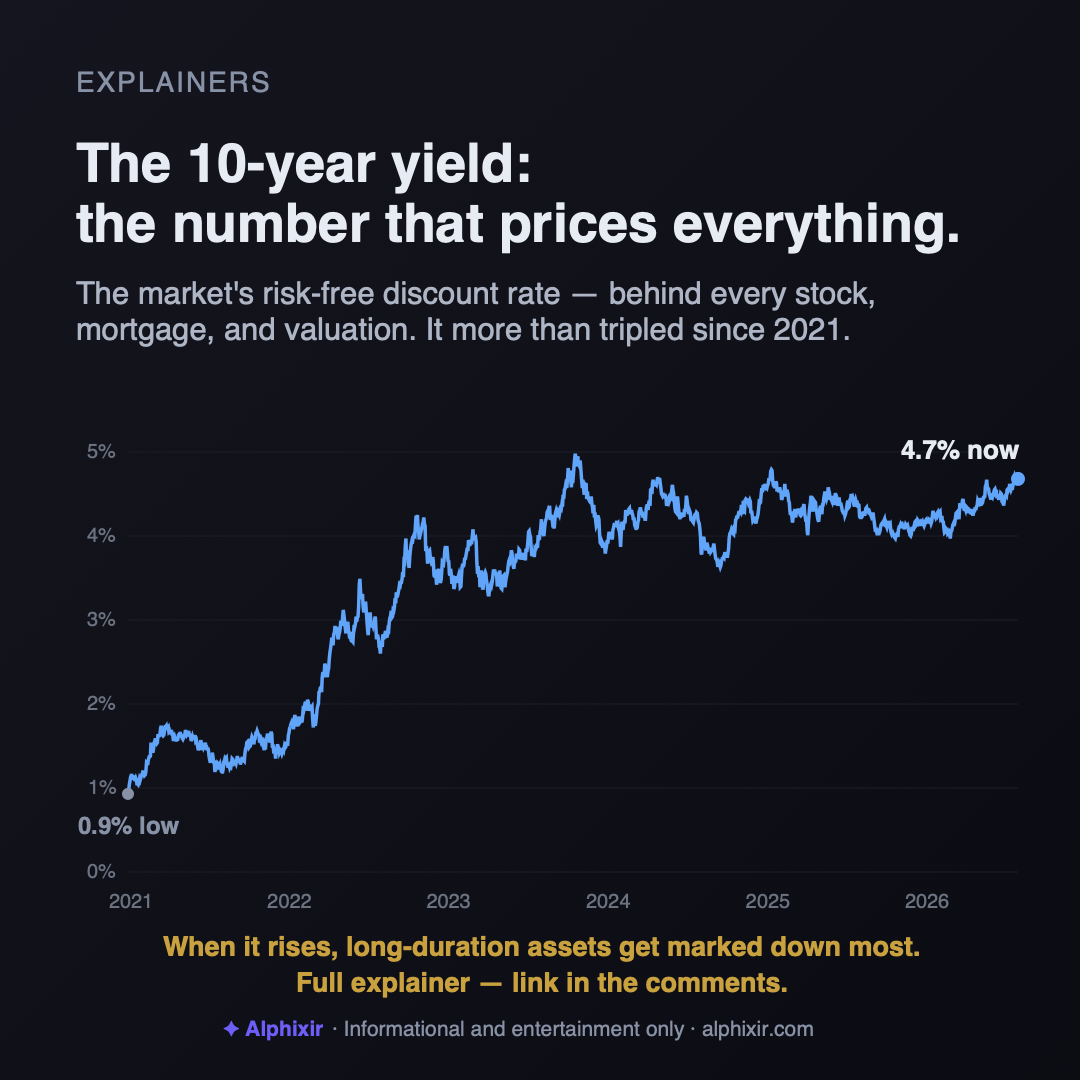
Start with what it is. When you buy a 10-year Treasury, you're lending money to the U.S. government for a decade. The yield is what it pays you. Because the U.S. can print the dollars it owes, that yield is treated as the closest thing markets have to a "risk-free" return over ten years — the baseline reward for doing nothing risky at all. Here is a quarter-century of that baseline:
Why one yield prices everything else
That baseline is why it prices everything else. Any asset — a stock, a rental property, a private company — is ultimately worth the cash it will throw off in the future, converted into today's dollars. To do that conversion you need a discount rate, and the 10-year yield is the market's anchor for it. When the yield is low, future dollars are worth almost as much as today's, so investors will pay up for growth that's years away. When the yield rises, those far-off dollars get marked down — and the assets whose payoff is furthest in the future (fast-growing tech, long-duration bonds, speculative bets) get marked down the most. Same companies, same story; just a heavier discount.
The arithmetic is brutal in a way words undersell. Here's what $100 of future cash is worth today, discounted at the 2021-style rate versus today's:
| $100 arriving in… | Worth today at 1% | Worth today at 4.68% | Haircut |
|---|---|---|---|
| 5 years | $95.15 | $79.56 | −16% |
| 10 years | $90.53 | $63.29 | −30% |
| 20 years | $81.95 | $40.06 | −51% |
| 30 years | $74.19 | $25.36 | −66% |
This is why the last few years quietly re-rated the whole market. The 10-year yield bottomed near 1% in 2021 (and 0.52% in the 2020 panic) and now trades around 4.7%. Nothing about that is a stock-market headline on its own, but it changed the gravity every asset is priced against. A rally that looked cheap at 1% looks very different when the risk-free alternative pays 4.7% — a dollar of profit promised thirty years out is worth roughly a quarter of what the same promise fetched at the low.
It's in your mortgage, too
If the discount-rate framing feels abstract, look at the most familiar consumer price in America. The 30-year mortgage rate is, mechanically, the 10-year yield plus a spread — lenders price a decades-long loan off the same risk-free anchor as Wall Street:
It cuts both ways, too. A higher 10-year rewards savers and anyone holding short-duration cash, and it hands the market a real alternative to stocks for the first time in a decade. "Higher rates are bad" is too simple — it depends entirely on which side of that discount rate you're standing on.
For our engine, the 10-year isn't a headline to trade off — it's one of the macro inputs that shapes posture: how much to risk on a given morning, before deciding what to hold. When the discount rate is high and rising, the environment is less forgiving of paying up for the far future, and the read leans more careful. Not a forecast — a lean, sized to the backdrop. Like every input we use, it's shown, not asserted.
1. The 10-year yield is the market's discount rate — the gravity every asset is priced against, from tech valuations to your mortgage.
2. Its move from 0.52% (2020) to roughly 4.7% re-rated everything: $100 arriving in 30 years is worth ~$25 today at the new rate vs. ~$74 at 1%.
3. Higher isn't simply "bad" — it punishes far-future payoffs and rewards savers. What matters is which side of the discount rate you're on. A backdrop, not a forecast.
Informational and entertainment content only. Not investment advice. 10-year Treasury yield (DGS10) and 30-year mortgage rate (MORTGAGE30US) from FRED; charts and the discount table are recomputed from live FRED data on every update. Past patterns are not predictions.